TRANSITION IT NOW ← Back to BMTG
What the reports look like

See the full report before you ever order one.

Every BMTG report is built to be read at a glance and co-branded for your practice. Below are anonymized samples of each report type, with every section shown, in the exact format your patients and your file receive.

These are samples. All patient details are fabricated, all values and findings are illustrative, and the neurologist is shown without identifying details. No real patient information appears on this page.
Co-branded The header carries your clinic's logo and practice name. The report is delivered under your brand, powered by BMTG.
YOUR
LOGO
[ Your Practice Name ]
Neurodiagnostic report
Powered by Brainwave MedTech Group Objective neurodiagnostic reporting
SP
Sample Patient
Patient
GenderFemale
Age58
DOBSample

Brainwave Performance Testing & Assessment

Test dateSample
Requested onSample
Assigned toBoard-certified neurologist
Report dateSample
Board-certified neurologist
Board-certified neurologist. Credentials on file, available on request.
Neurologist signature
on file
Neurologist statement

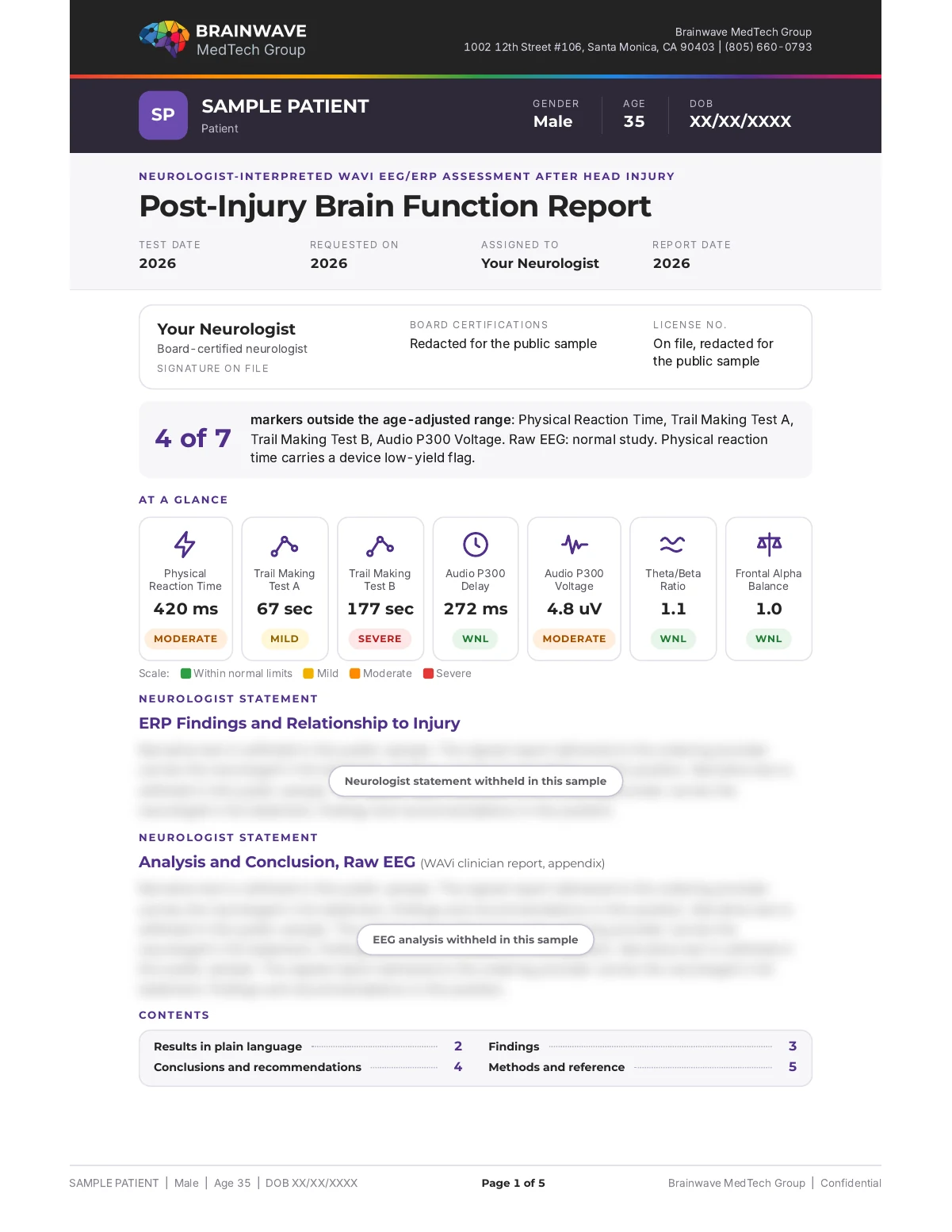
ERP findings and correlation to TBI

As noted in Section I: summary of observations and findings

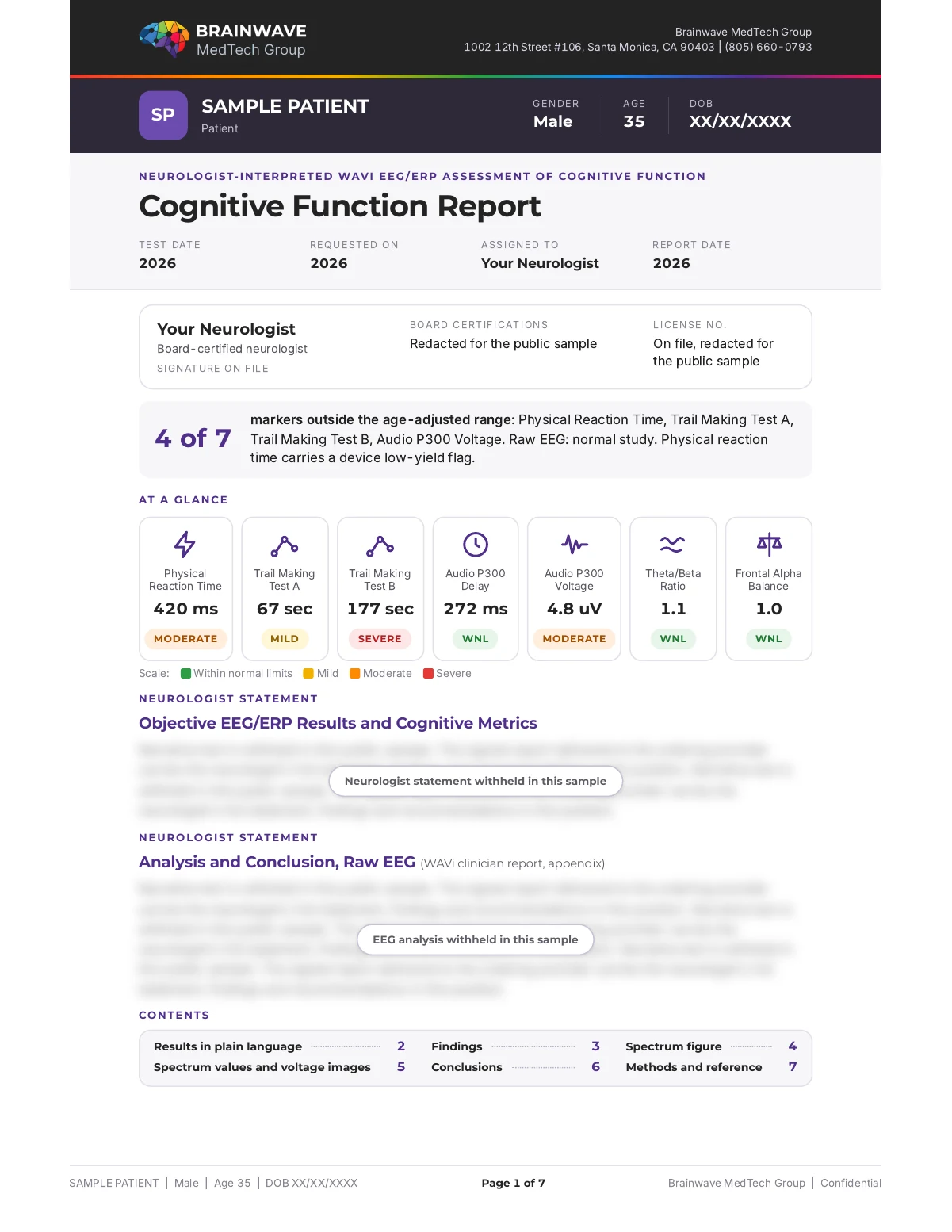
CZ Eyes Closed Theta/Beta has been age adjusted and is within normal limits. Physical Reaction Time, Audio P300 Delay, Audio P300 Voltage, and Frontal Alpha Balance show averages that can be associated with concussions in the appropriate clinical setting. These findings can indicate cognitive impairment and behavioral issues typically associated with the event in question.

Physical Reaction Time
Severe
Trail Making Test A
Severe
Trail Making Test B
WNL
Audio P300 Delay
Severe
Audio P300 Voltage
Moderate
CZ Eyes Closed Theta/Beta
WNL
Frontal Alpha Balance
Mild
WNL Within Normal Limits
Neurologist statement

Analysis and conclusion, EEG raw brainwaves

The background consisted of a mixture of frequencies, predominantly in the 10 Hz range. No epileptiform or seizure activity was noted. This is a normal EEG study. A normal or unremarkable study does not necessarily rule out the presence of a seizure disorder or tendency for unprovoked seizures.

Section I · Observations and findings

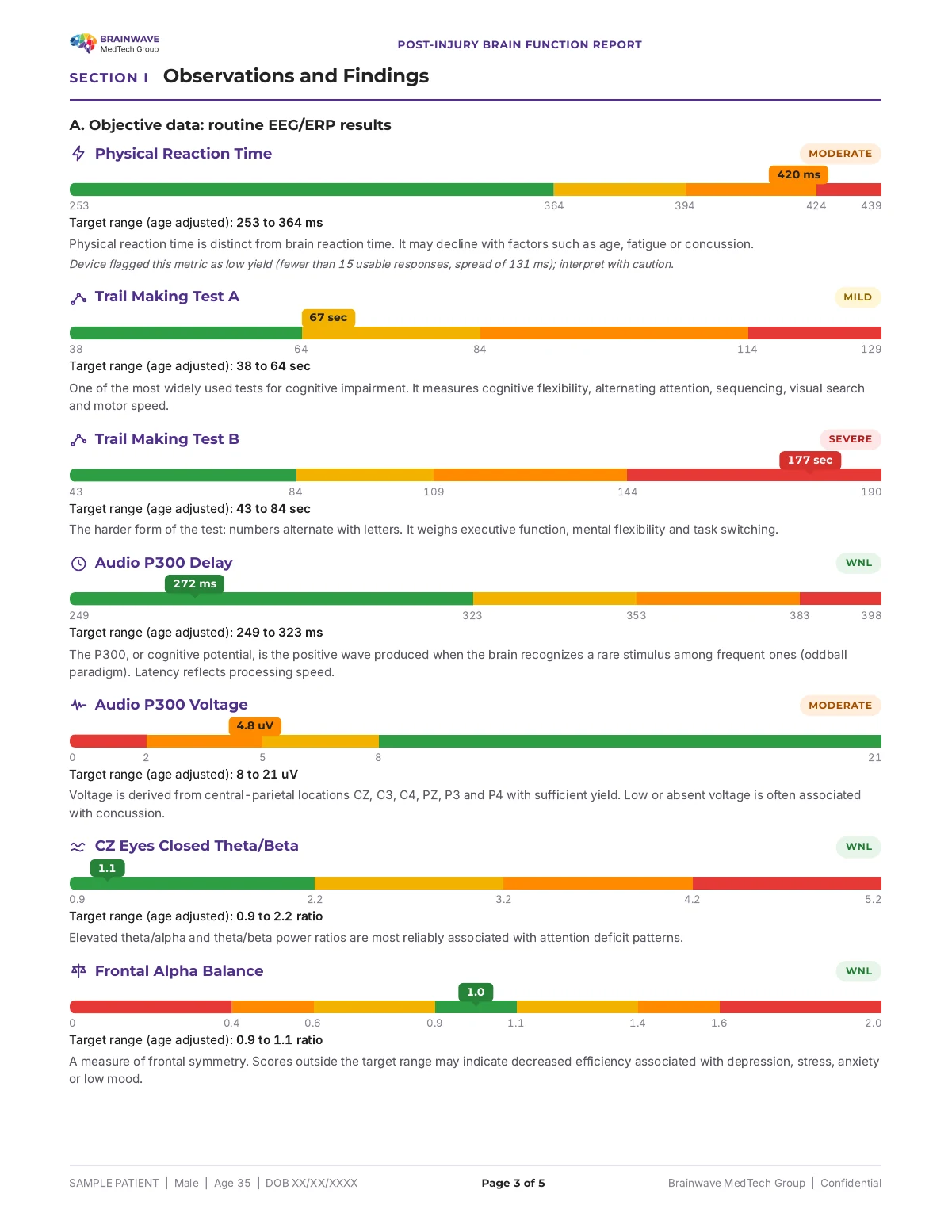
A. Objective data, routine EEG / ERP results
Physical Reaction TimeSevere
674
257370430674
Target range (age adjusted): 257 to 370 ms
Physical Reaction Time is distinct from Brain Reaction Time. It can decline with age, fatigue, or concussions.
Trail Making Test ASevere
181
5493143181
Target range (age adjusted): 54 to 93 sec.
A widely used measure of cognitive flexibility, alternating attention, sequencing, visual search, and motor speed.
Audio P300 DelaySevere
432
278361421436
Target range (age adjusted): 278 to 361 ms
The P300 cognitive potential is elicited by recognition of a rare stimulus. Delay can be associated with concussions.
Audio P300 VoltageModerate
3.3
04717
Target range (age adjusted): 7 to 17 uV
Derived from central-parietal locations. Low voltage is often associated with concussions.
CZ Eyes Closed Theta/BetaWNL
0.9
0.71.72.74.7
Target range (age adjusted): 0.7 to 1.7
Elevated Theta/Beta power ratios are most reliably associated with attention regulation.
Frontal Alpha BalanceMild
1.4
00.91.12
Target range (age adjusted): 0.9 to 1.1
A measure of frontal symmetry. Scores outside the target range can reflect decreased efficiency.
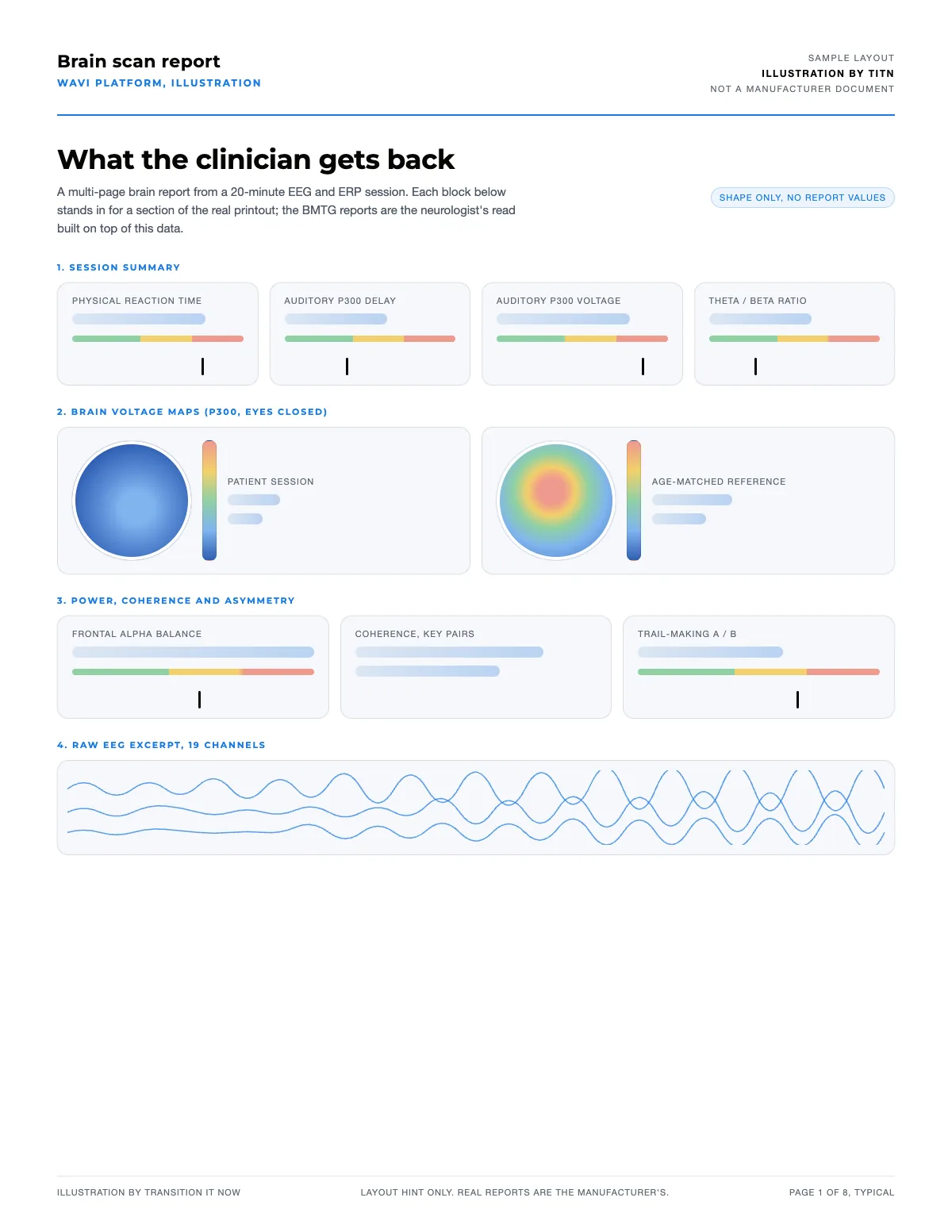
B. Brain voltage images
Patient brain
Sample, P300 EC
Exhibiting symptoms
MAX
MIN uV
Normal brain
Reference, P300 EC
Example only
MAX
MIN uV
Topographic brain-voltage maps are illustrative placeholders in this sample. The real report shows the patient's own session images.

Conclusions and recommendations

  • Physical reaction time is abnormally prolonged, which correlates with one of the trail making tests.
  • Prolonged Audio P300 latency and low Audio P300 voltage are noted, non-specific markers of reduced cognitive functioning that can be secondary to many causes, including brain trauma. Clinical correlation is recommended.
  • Theta/Beta ratios, which evaluate for attention regulation, are within normal limits.
  • Frontal alpha power, which evaluates for anxiety and mood, is outside the reference range.
  • Final determination is to be made by the treating physician. This report provides objective metrics of brain function to aid the diagnostic work-up; it does not provide a final diagnosis.

Treatment recommendations

  1. Correlate abnormal physical reaction time to underlying neurological status.
  2. Correlate abnormal P300 latency and voltage to underlying neurological status.
  3. Correlate with computerized or in-person cognitive testing.
  4. Correlate with cerebral imaging (MRI with DTI, SWI) to evaluate for structural findings.
  5. Nutritional consultation and a balanced, heart-healthy diet.
  6. Cognitive retraining targeting the areas of weakness.
  7. Pharmacological and non-pharmacological interventions for mood as needed.
  8. Clinical outcomes management to monitor post-concussive symptoms over time.
  9. Non-pharmacological options such as photobiomodulation (red-light therapy), molecular hydrogen inhalation, and hyperbaric oxygen may be considered to support recovery.
  10. Neurobehavioral reevaluation and objective retesting to reassess plan efficacy.
  11. Consider a repeat EEG / ERP study to evaluate improvement with treatment.

Section II · Clinical statement and support documents

About the Brainwave Report

The Brainwave Report produces authoritative medical analysis for patients undergoing brain performance testing using routine EEG / ERP, an FDA-cleared, non-invasive method that objectively tracks and records brainwave patterns in real time. The EEG / ERP test is a tool for tracking and observing brain-state changes. It also provides auditory and visual evoked potentials using P300 latency, an ERP component used to evaluate cognitive functions such as attention, working memory, and concentration, along with physical reaction time, brain speed, and brain voltage.

Confidential notice

This information is intended only for the use of the individual or entity named in the report. The authorized recipient is responsible for securing it in accordance with applicable federal and state law. Unauthorized use, disclosure, copying, or distribution is prohibited.

Copyright notice

This Brainwave Report is a copyright of Brainwave MedTech Group and is intended exclusively for private use by the assigned qualified medical professional. Third-party access requires written consent from Brainwave MedTech Group.

About the neurologist

A board-certified neurologist signs every report. Credentials are on file and available on request.

Sample report shown for illustration only. The WAVi data is an aid in diagnosis (FDA 510(k) K213900), not a standalone diagnosis. Interpretation is the neurologist's. The TBI Report does not assign legal causation; admissibility is determined by the court under the applicable evidentiary standard.