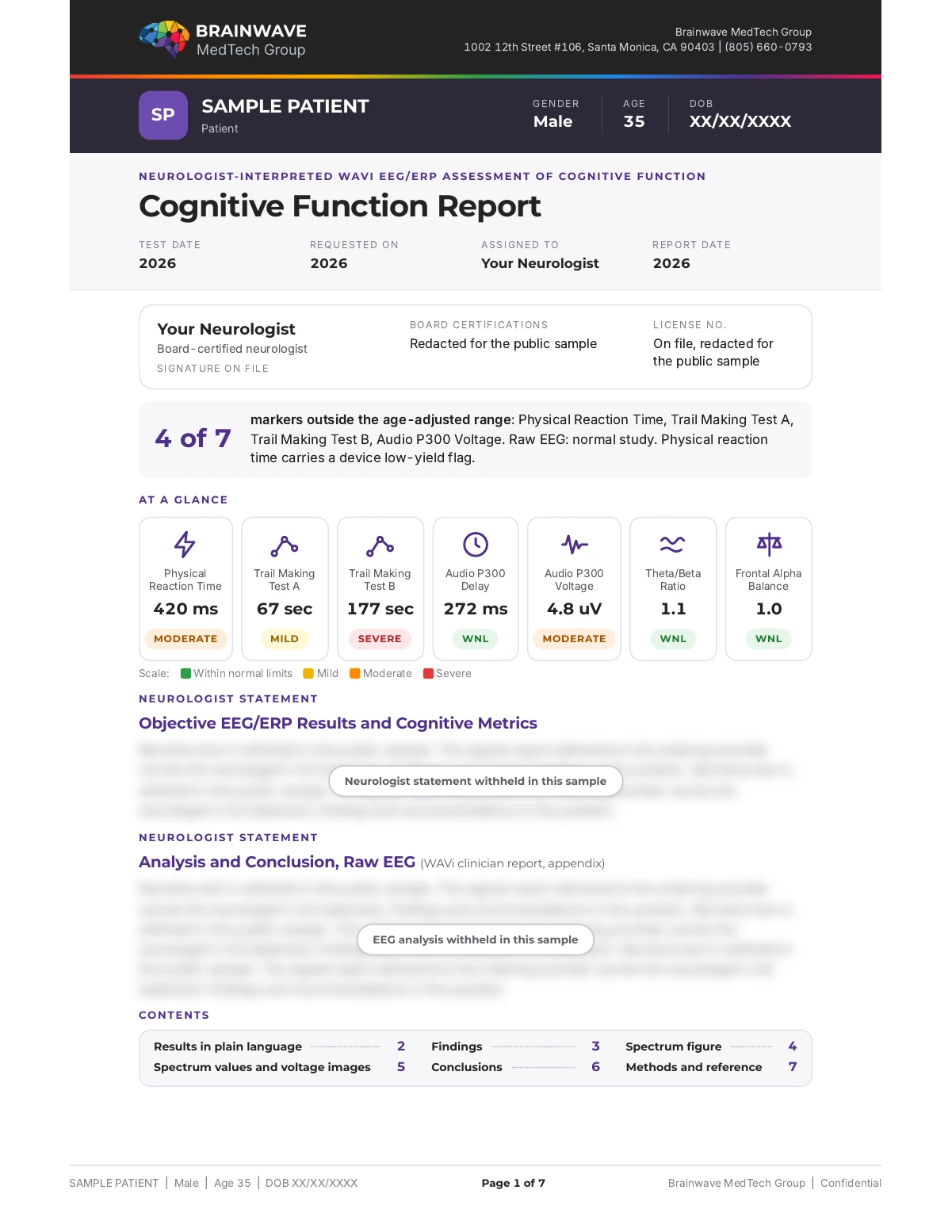
BMTG is TITN's sister service for clinical interpretation. Your team runs the scan; BMTG turns the data into the report. Two distinct tracks: the Cognitive Function Report for clinical cognitive assessment, and the Post-Injury Brain Function Report for med-legal cases. Different scans, different audiences.

BMTG produces two deliverables, and they do not overlap. The clinical track (left) is a cognitive assessment for physicians, built on WAVi plus autonomic data. The med-legal track (right) is a WAVi-only Post-Injury Brain Function Report ordered by the treating provider when a patient's injury becomes a legal matter, signed by a board-certified neurologist.
Cognitive assessment for functional medicine, longevity, and geriatric mild-cognitive-impairment care. Built on WAVi (EEG and ERP) plus autonomic (ANS) data, interpreted by a BMTG board-certified neurologist or your own on TITN's templates. Delivered through TITN's HIPAA-compliant portal. The report does not diagnose mild cognitive impairment; it documents measured data a clinician interprets.
Neurodiagnostic documentation for the patients whose injury becomes a personal-injury matter, signed by a board-certified neurologist. Ordered by the treating provider, WAVi only, with quantified EEG and ERP findings. Available as a standalone deliverable with no device purchase required.
The same four-step path runs both tracks. Your staff captures the scan, the data lands in the HIPAA portal, a neurologist interprets it, and the finished report routes back to the ordering provider. You stay the point of contact with your patient.
Your team runs WAVi (and the autonomic ANS scan for the clinical track) chairside. Standard protocol, no neurology expertise required at the device.
Scan data lands in TITN's HIPAA-compliant portal. Secure handoff, no email of patient data, no loose files.
A neurologist reads the data. Clinical reports use BMTG's board-certified neurologists or your own; med-legal Post-Injury Brain Function Reports are signed by a board-certified neurologist.
The finished report comes back to you on TITN's templates, ready for the chart, the claim, or the legal record.
The med-legal track carries the signature of a board-certified neurologist. Credentials are on file. Ask your TITN contact, or email support@transitionitnow.com, for the credentials packet: board certification and licensure. That signature is what makes a Post-Injury Brain Function Report a physician-signed document rather than a printout. Admissibility is decided by the court and varies by jurisdiction.
BMTG Case Reviews is our own program. It puts complex presentations across both report tracks in front of a second neurologist. The BMTG team interprets each case against WAVi's own normative database, not in isolation.
BMTG Case Reviews supports both the clinical Cognitive Function track and the med-legal TBI track. For clinics, that means complex cognitive presentations can be escalated to BMTG's board-certified neurologists for review. For the ordering provider, it means the Post-Injury Brain Function Report sits inside a working clinical program, not a one-off read. Ask your TITN contact how case reviews fit your practice.
Book a 15-minute call. We will sort the clinical track from the med-legal track, map the scans and codes, and walk you through how the report comes back through the HIPAA portal. Then you pick the page that fits.
What an ordering clinic asks about the report layer.
BMTG is the clinical-interpretation layer behind TITN's brain scans. A neurologist reads the data and returns a signed report through TITN's HIPAA-compliant portal, and the med-legal Post-Injury Brain Function Report is signed by a board-certified neurologist. The ordering clinic is the customer, and the report is theirs.
The Cognitive Function Report is a clinical cognitive assessment combining WAVi and TM-Flow autonomic data, interpreted by a BMTG board-certified neurologist or your own. The Post-Injury Brain Function Report is a WAVi-only med-legal deliverable signed by a board-certified neurologist.
The ordering provider bills the underlying scans under its own payer contracts; coverage is decided by the payer on the documented indication. TITN publishes no reimbursement figure.
No. BMTG is provider-first: the treating clinic orders the testing and owns the report. When a patient's injury becomes a case, the provider may share the Post-Injury Brain Function Report with counsel as documented, measured neurodiagnostic data. Admissibility is decided by the court and varies by jurisdiction.
This page describes BMTG report tracks. Where it references device clearances or reimbursement, the supporting sources are below. Spot a broken or outdated link? Email support@transitionitnow.com.