BMTG · Med-Legal Track

The TBI Report for personal-injury cases.

Objective brain-injury evidence the record can stand on.

Objective neurodiagnostic documentation built on FDA-cleared WAVi EEG and ERP data, signed by a board-certified neurologist. Quantified biomarker evidence for traumatic brain injury, documented for the record. Available as a standalone deliverable: no device purchase, no clinic build-out required.

WAVi FDA 510(k) K213900 Neurologist-signed Cash-pay or lien
WAVi only
EEG + ERP biomarker basis
K213900
FDA 510(k) cleared platform
Board-certified
Neurologist-signed
Standalone
No device purchase needed
Cash or lien
By case structure
What the TBI Report Is

Objective neurodiagnostic documentation, ordered when your patient's injury becomes a case.

A traumatic brain injury is real even when the CT and MRI read as normal. The TBI Report (formerly presented as the Brainwave Report, BWR) is BMTG's med-legal track. Ordered by the treating provider, it is a WAVi-only deliverable: objective neurodiagnostic documentation, signed by a board-certified neurologist. The report you order and can share with counsel documents function, not just structure, and stands behind the case file, the deposition, and the courtroom.

The deliverable
WAVi EEG / ERP · interpreted, signed, written for the record
Med-legal track
What goes in the report
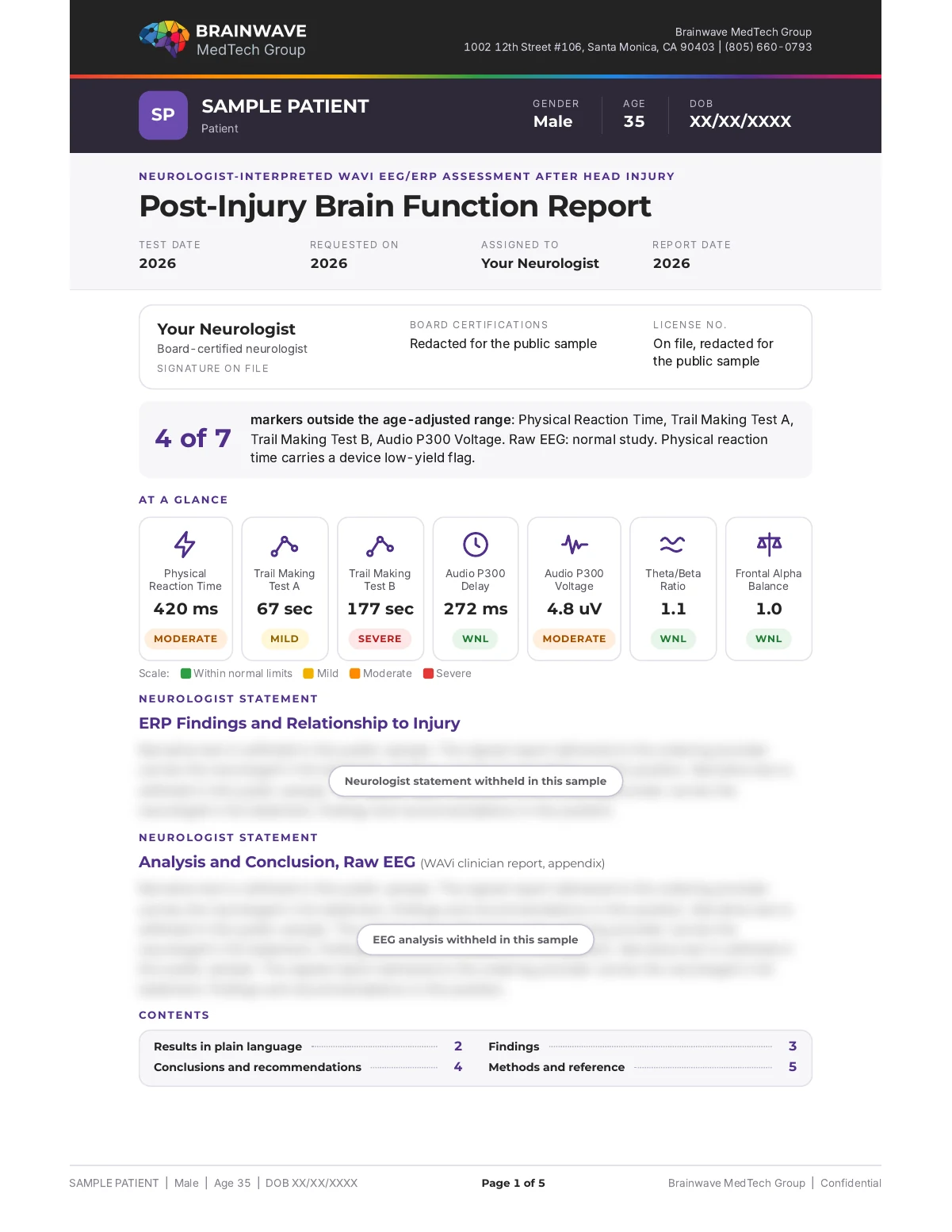
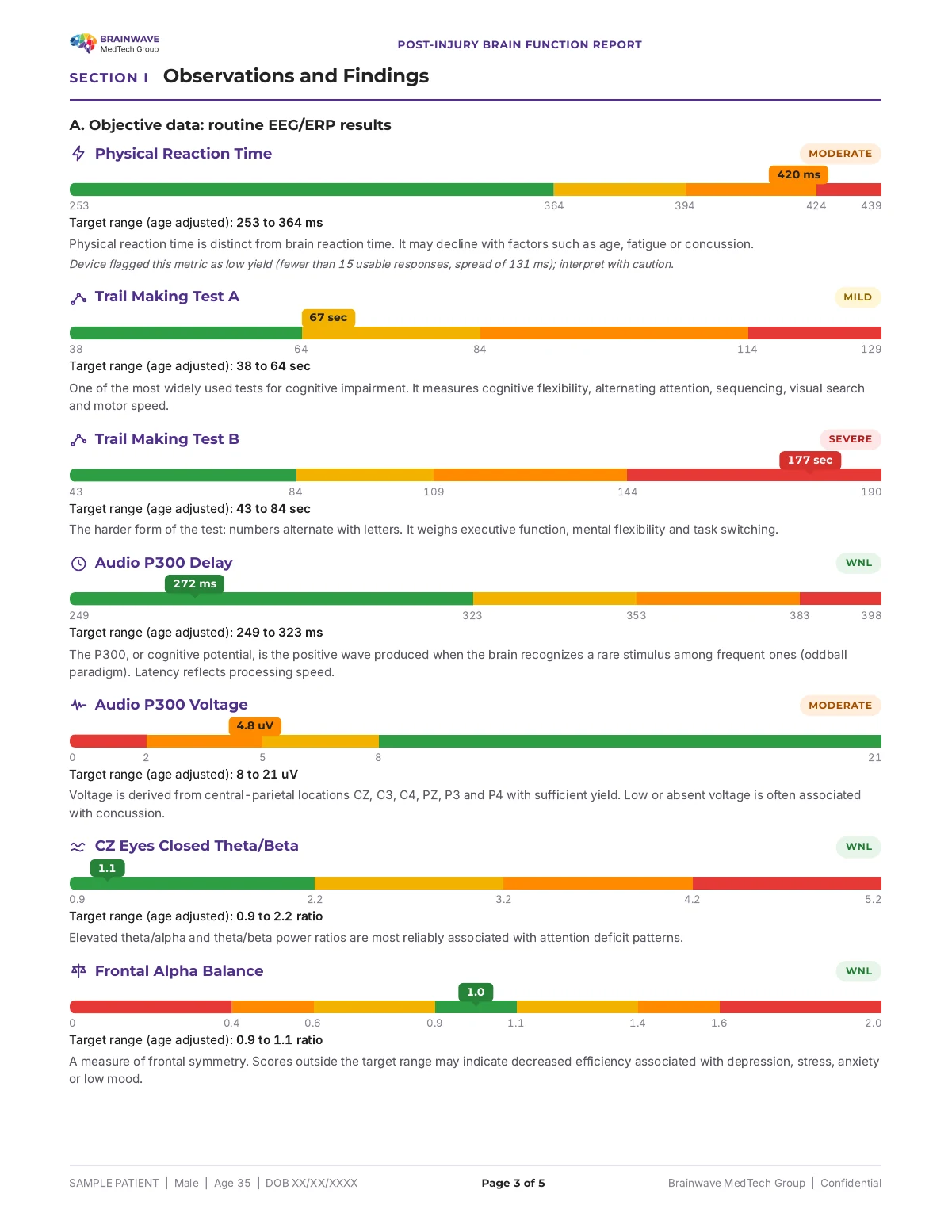
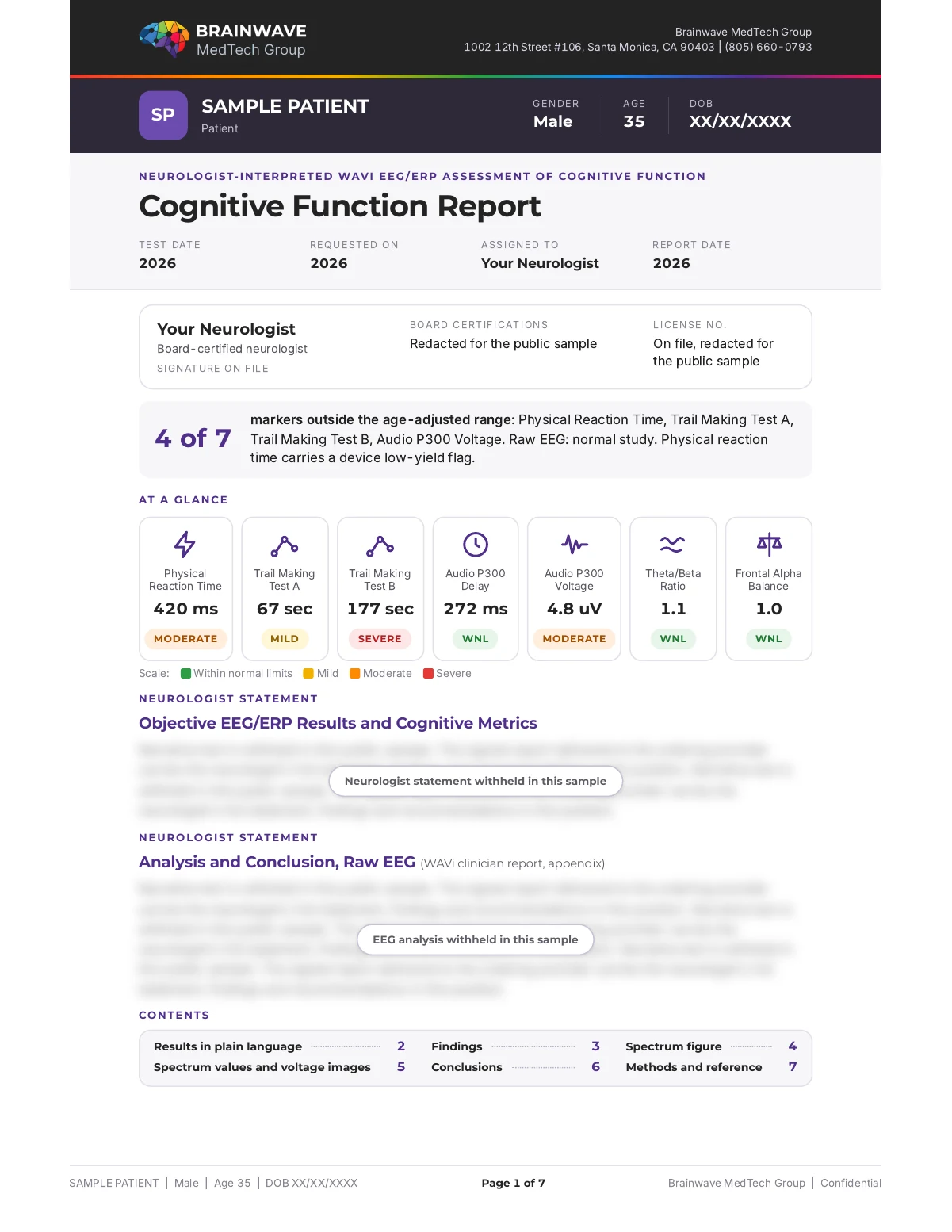
  • Quantified EEG · resting brain wave activity measured against a normative database
  • ERP / P300 · event-related potentials, an objective marker of cognitive processing
  • Plain-English findings · what the data shows, written for a non-clinical reader
  • Neurologist signature · a named, board-certified expert behind every conclusion
Report exhibit
[Sample TBI Report exhibit page, anonymized, EEG findings + signature block]
Why providers order it
For the ordering provider and clinic
The problem it solves
In a mild-TBI claim, standard imaging often comes back clean, and the defense leans on that. The TBI Report puts an objective, quantified measure of brain function in the file: the kind of evidence that holds up under scrutiny because it is reproducible and instrument-recorded.
Where it fits
  • Motor-vehicle and slip-and-fall TBI claims
  • Demand packages and pre-litigation negotiation
  • Expert support for deposition and trial
  • Cases where symptoms outlast a normal scan
The standalone advantage: the TBI Report is available as a deliverable on its own. The ordering provider does not need to own a WAVi system or run a WAVi-equipped clinic; BMTG coordinates the scan and the read.
Admissibility & Scope

What the TBI Report claims, and what it does not.

Evidence is only useful if it survives cross-examination. The TBI Report is precise about its scope: it presents objective, instrument-recorded biomarker data interpreted by a qualified expert. It does not overreach, which is exactly what makes it defensible.

The evidentiary basis
FDA-cleared instrument · qualified expert · reproducible method
510(k) cleared
The underlying platform
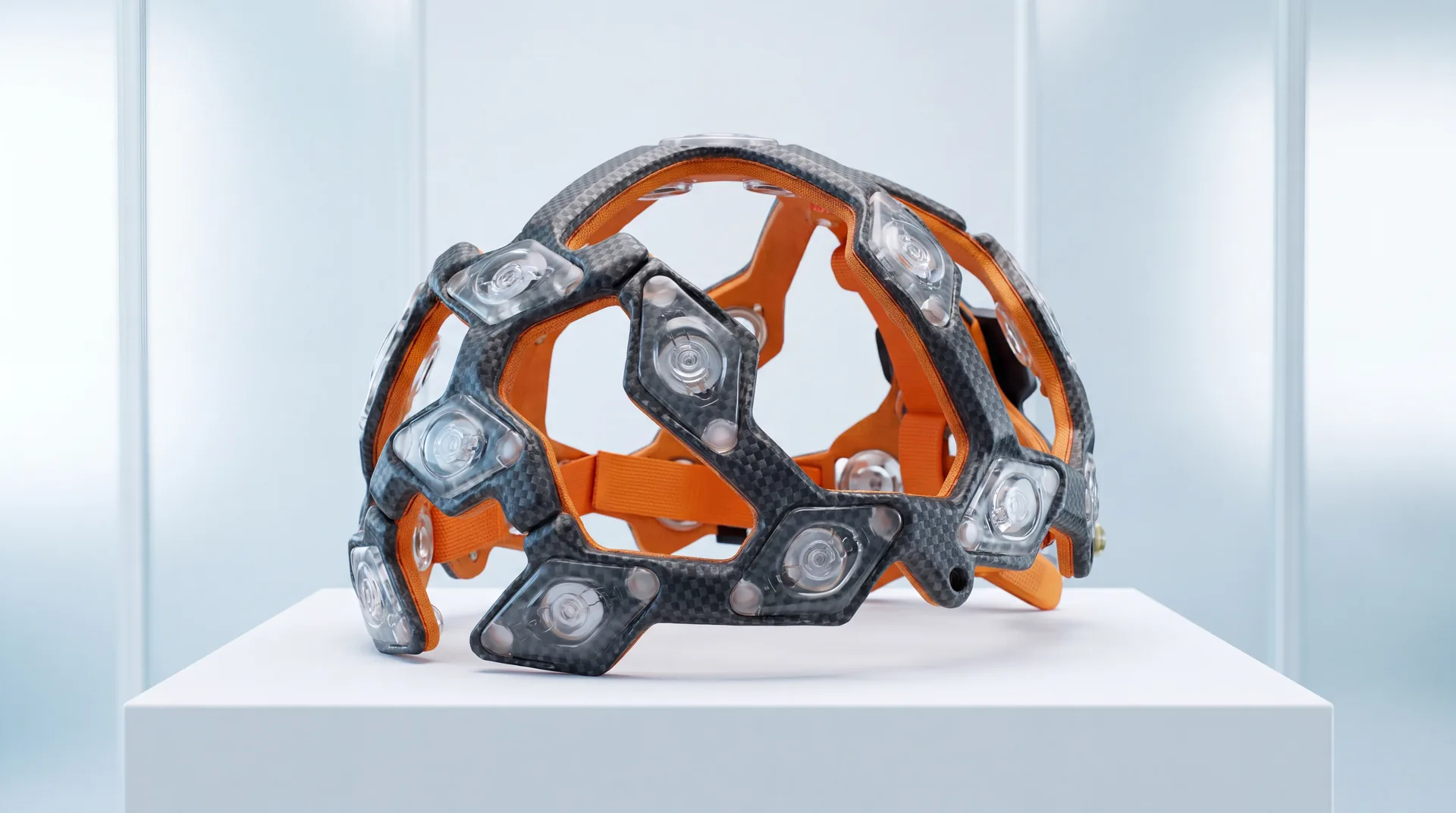
The TBI Report is built on the WAVi Scan System, an FDA 510(k) cleared EEG and ERP platform.
K213900 · WAVi SCAN EEG System and Accessories. Product code GWQ, regulation 21 CFR 882.1400 (electroencephalograph), Class II. Cleared May 2022.
View FDA 510(k) record →
WAVi indications for use (verbatim)
"WAVi SCAN software is intended for the acquisition, display, and storage of electrical activity of a patient's brain including electroencephalograph (EEG) and event-related potentials (ERP) to aid in diagnosis."
Scope discipline
Why precision is the strategy
What the TBI Report claims: objective, quantified EEG and ERP biomarker findings, recorded on an FDA-cleared instrument and interpreted by a named, board-certified neurologist. The report documents measurable brain-function abnormalities consistent with the clinical picture, written to be understood by the court.
What the TBI Report does not claim: it is not a substitute for the treating clinician's judgment, it does not assign legal causation or liability, and the underlying WAVi data is an aid in diagnosis, not a standalone diagnosis of any condition. Admissibility is ultimately the court's determination under the applicable evidentiary standard.
Where the report goes
Like all BMTG reads, the TBI Report routes back to the ordering provider, who remains the patient's point of care. The provider shares the report with counsel per the case workflow.
The Signature Behind the Report

Every TBI Report is signed by a board-certified neurologist.

A report is only as strong as the expert behind it. TBI Reports are signed by a board-certified neurologist. Credentials are on file and available to qualified parties on request.

Board-certified, credentials on file
Board-certified neurologist

A board-certified neurologist signs every TBI Report. Credentials are on file and available to qualified parties on request.

Board-certified neurologist
How the TBI Report Process Works

From referral to signed report, no clinic build-out.

The standalone path keeps it simple for the ordering provider or a clinic that does not run WAVi in-house. BMTG handles the scan logistics and the neurologist read; the report comes back through TITN's HIPAA-compliant portal.

01

Engage

The ordering provider or referring clinic opens the case and confirms structure: cash-pay or lien, depending on how the matter is set up.

02

Scan

The patient is scanned on a WAVi system at a coordinated location. About twenty minutes, run by a trained tech, not the physician.

03

Interpret

The neurologist reviews the quantified EEG and ERP data and interprets the findings against the normative database and the clinical picture.

04

Sign & deliver

The signed report routes back to the ordering provider through TITN's HIPAA-compliant portal, written in plain English for the record.

05

Support

If the case proceeds, the neurologist can stand behind the findings for deposition or trial. Objective data, named expert.

The Science, In Plain English

Why brain-wave data adds something imaging cannot.

You do not need a neuroscience background to understand the value. Three ideas carry the report.

Function, not just structure

CT and MRI show anatomy. EEG and ERP measure how the brain is actually working, which is where mild TBI shows up first.

The P300 marker

The P300 is a well-studied event-related potential tied to attention and processing. Changes in it are an objective, peer-reviewed window into cognitive impact.

Quantified and reproducible

QEEG scores the client's data against a normative database using a fixed protocol. The output is a measurement, acquired the same way every time, not a reader's impression.

Engagement & Fit

Built for the ordering provider, the treating clinic, and the med-legal TBI case.

Two structures, depending on the case. Cash-pay where that fits the matter, or lien-based where the recovery model calls for it. Either way, the report routes back to the ordering provider.

Cash-pay
Direct engagement
For matters where the report is commissioned directly. Clear scope, defined deliverable, and a named expert signature. Pricing is set per case at engagement.
Lien-based
Tied to case structure
For cases run on a lien model, the TBI Report can be structured against the matter and paid at resolution. We confirm the right path at intake.
Who reaches for the TBI Report
See It + Explore BMTG

Review a sample, then see the rest of BMTG.

Have a TBI case where the scan came back clean?

Request an anonymized sample TBI Report, or book a 15-minute call to walk through how the report is built, who signs it, and how cash-pay or lien structures fit your practice.

Or reach us directly: roberto@transitionitnow.com · (213) 444-6123 · Santa Monica, CA
Common questions

The TBI Report, answered.

What a provider asks about the med-legal track.

What is the TBI Report?

A WAVi-only deliverable: objective EEG and event-related-potential documentation for traumatic brain injury, signed by a board-certified neurologist. The treating provider orders it, not an attorney.

What does the TBI Report claim, and what does it not?

It is objective neurodiagnostic documentation of measured brain electrical activity. It does not assert legal causation or guarantee admissibility. Admissibility is ultimately the court's determination.

Who signs it?

Every TBI Report is signed by a board-certified neurologist. Credentials are on file, available on request.

Why add brain-wave data to a case?

EEG and ERP capture functional brain electrical activity that structural imaging can miss, giving the treating provider objective documentation for the clinical record. The provider decides whether and how to share it with counsel.

Sources & verification Every clearance and figure on this page traces to a live source. View the sources

Spot a broken or outdated link? Email roberto@transitionitnow.com.

FDA & regulatory

  1. FDA 510(k) record K213900 · WAVi SCAN EEG System and Accessories, Wavi Co., Class II, product code GWQ, 21 CFR 882.1400, decision date 06 May 2022
  2. FDA 510(k) Premarket Notification database · searchable clearance records
  3. WAVi Regulatory Update · verbatim indications for use

Manufacturer documentation

  1. WAVi research index · manufacturer-curated white papers, publications, and case studies
  2. WAVi Scan Manual / IFU (PDF)

Peer-reviewed clinical context

  1. Polich J. (2007) · Updating P300: an integrative theory of P3a and P3b. Clinical Neurophysiology. (Foundational ERP reference.)
  2. Bigler et al. (2018) · Cortical thickness in pediatric mild traumatic brain injury including sports-related concussion. International Journal of Psychophysiology. General peer-reviewed context on mild-TBI assessment, not a TBI Report-specific study.

Scope & methodology notes

  1. Engagement structure (cash-pay or lien-based) is set per case at intake; no fixed figures are published here.
  2. The TBI Report is a med-legal interpretation product built on WAVi data; admissibility is determined by the court under the applicable evidentiary standard.
  3. Reports route to the ordering provider. Provider and clinic names are withheld for confidentiality.
Have a TBI case? Request a sample